For most Greece yacht charters, round trip is still the simpler and more cost-effective option. We recommend a one-way charter when it saves meaningful transit time, unlocks a better route, or makes a high-priority itinerary much more realistic.
In our experience, this decision is rarely about whether 1 format sounds more exciting. It is about whether a one-way route genuinely improves the week enough to justify the extra logistics, possible delivery costs, and tighter dependence on the yacht’s calendar.
We talk clients through this all the time. Sometimes round trip is clearly better. Sometimes one-way is the move that makes the whole charter make sense. The key is matching it to the area, the yacht type, the number of days, and how fixed your must-see stops really are.
| Round trip | One way | |
|---|---|---|
| In the Cyclades | Doubling back costs you days | See much more, and finish in the islands |
| In the Ionian | A natural loop, easier week | Strong for a Corfu to Zakynthos run |
| In the Saronic | Short hops, the obvious fit | Adds cost with little advantage |
| What it costs | Fuel for the return, inside your APA | A one-way fee on top |
| Choice of yacht | The whole fleet is open | Only boats that can finish there |
| If weather turns | Captain can reshape the route | Fixed handover, less room to move |

Broker insight
Round trip is the default for a reason. It keeps the yacht choice open and the price down, so we only push one-way when the route genuinely calls for it.
 John Boullin
Charter Broker
John Boullin
Charter Broker
Why Round Trip Is Still the Default
Round trip is still the default because it is easier operationally. The yacht starts and ends in the same place, the crew schedule is simpler, provisioning and turnarounds are cleaner, and you usually avoid the extra repositioning cost that can come with delivering the yacht back afterward.
That matters more than many first-time clients expect. A round-trip charter often gives the captain more flexibility to adjust the route inside the same cruising area without the pressure of needing to finish far away on a fixed handover day. If weather shifts, the yacht still has more room to reshape the week without a hard geographic finish line. That is 1 reason round trip can be especially attractive in Greece, where route realism and weather flexibility often matter more than the map suggests at first glance. Our guide on what happens if weather changes on a Greece yacht charter goes deeper into that side of the decision.
When a One-Way Charter Is Worth It
We recommend one-way when it solves a real route problem, not just because it sounds more adventurous. The best reason to pay for a one-way is that it removes an otherwise transit-heavy section of the week and replaces it with more time in the cruising area you actually care about.
A good example is a Cyclades week where the client wants the headline islands but does not want to spend the first part of the charter just reaching them from the mainland. Another good use case is an Ionian route that wants to travel meaningfully north to south, rather than looping back just because the yacht has to return to its original base.
The key question is simple: does the one-way route give you a noticeably better week, or does it just move the handover point? If it is only the second, we usually steer clients back toward round trip.
The Cyclades: Where One-Way Often Makes the Most Sense
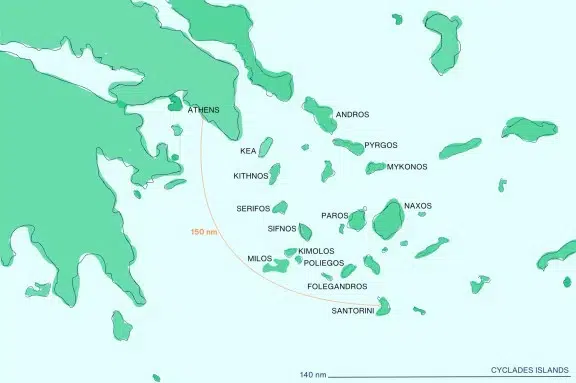
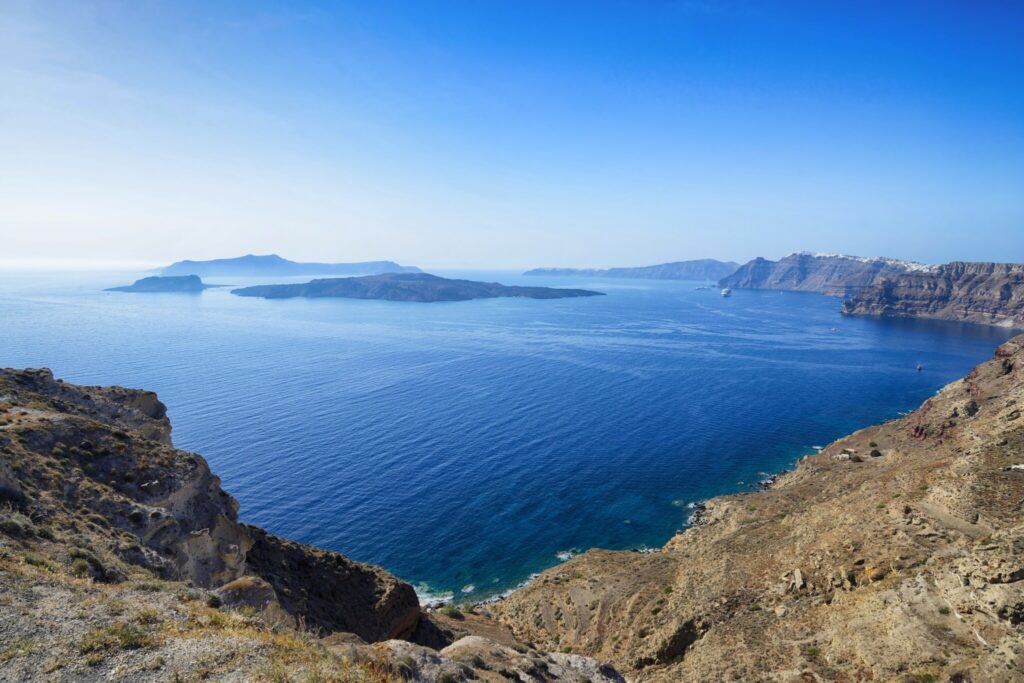
The Cyclades are where one-way often becomes the smarter answer, because this is the part of Greece where distance and exposure start to bite. If the brief is built around islands like Mykonos, Paros, Ios, or Santorini, a one-way charter can save a meaningful amount of charter time compared with forcing the yacht to return to the mainland at the end.
We see this most clearly on 7-day charters. Athens to Mykonos is already a real leg. Athens to Santorini is much more so. If the route is trying to cover major Cyclades names and still feel like a vacation rather than a positioning exercise, one-way can be the thing that makes the itinerary feel balanced instead of rushed. That is exactly why we recently wrote our Athens vs island start guide and why our article on how far you can really go in 1 week in the Cyclades matters so much here.
That does not mean one-way is always best in the Cyclades. If the client is happy with a tighter island cluster, or the yacht type does not support ambitious distances comfortably, round trip can still be the better fit. But if the route goal is to reduce wasted movement and keep the week focused on the islands themselves, this is the Greece area where one-way often earns its keep most clearly.
The Ionian: Round Trip Is Often Easier, but One-Way Can Be Excellent
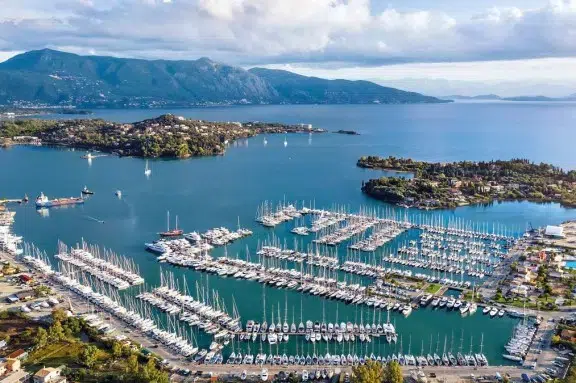
In the Ionian, round trip is often easier because the area is more forgiving and the cruising grounds naturally lend themselves to loops. Distances are generally more manageable, the seas are usually less exposed than the Cyclades, and clients can cover a satisfying amount of ground without needing to finish somewhere far away.
That said, the Ionian is also a very good place to do a proper one-way when the route is long enough to justify it. A north-to-south route such as Corfu toward Zakynthos can work beautifully because it avoids retracing your path and turns the week into a real progression through the islands. We already have both versions on the site: an Ionian one-way itinerary and an Ionian round-trip route example. That comparison shows the tradeoff very clearly.
So in the Ionian, our default is still round trip for simplicity. We recommend one-way when the client really wants the longer north-to-south sweep and the yacht calendar supports it well.
The Saronic: Round Trip Is Usually the Better Fit
The Saronic is where round trip usually wins very comfortably. The distances are shorter, the route is easier to shape into a satisfying loop, and the whole appeal of the area is that it gives you a smoother, less transit-heavy week close to Athens without needing extra logistical gymnastics.
If a client wants an elegant, easy Greece week with shorter passages, we would usually keep the Saronic round trip rather than trying to force a one-way concept onto it. A route like our 7-day Saronic itinerary already shows why: the area naturally gives you a full-feeling week without a long repositioning problem to solve.
Broker insight
One-way shines in the Cyclades when you want to end on Santorini or Mykonos without doubling back. The catch is the delivery cost, so we price both before you decide.
 Daniel Asmus
Owner, Charter Broker, Active CYBA Member, IYBA, ECPY
Daniel Asmus
Owner, Charter Broker, Active CYBA Member, IYBA, ECPY
What Most Clients Get Wrong
The most common mistake is assuming one-way is automatically the more premium or more efficient option. Sometimes it is. Sometimes it simply adds cost without improving the trip enough to justify it.
The other mistake is thinking only about the map and not about the yacht. A route that works very well on 1 yacht may be a poor fit on another, especially once speed, fuel burn, weather flexibility, and delivery cost come into play. That is why we compare route format, yacht type, and total charter cost together instead of treating them as separate questions. If you want the pricing side broken down, our Greece yacht charter cost guide is the best place to continue.
Our Recommendation
The right answer is not that one-way sounds better, or that round trip is safer. It is whichever format gives you the better charter for the yacht, route, and number of days you actually have. Our complete Greece itinerary guide shows how that plays out across different route families.
People also ask
Is round trip or one-way better for a Greece yacht charter?
For most Greece yacht charters, round trip is still the better default because it is simpler and usually more flexible. We recommend one-way when it noticeably improves the route and saves meaningful transit time.
Are one-way charters more expensive?
Often, yes. A one-way charter can involve delivery costs, crew logistics, and tighter calendar constraints. The important question is whether the route improvement is worth that extra cost.
Which Greece area is best for a one-way yacht charter?
The Cyclades are often the strongest case for one-way because distance and itinerary pressure matter more there. Some longer Ionian routes also work very well as one-way charters.
Is the Saronic better as round trip?
Yes, usually. The Saronic is compact enough that round trip often gives you a full-feeling week without needing a one-way structure.
Can a one-way route make the Cyclades more realistic?
Yes. In many cases, a one-way Cyclades route can make a 7-day charter feel much less transit-heavy, especially when the client wants headline islands and does not want to spend the week doubling back.













 iMessage
 WhatsApp