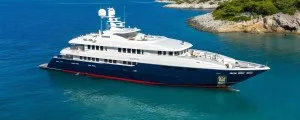
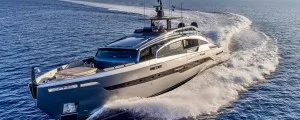
Fuel cost on a Greece yacht charter depends mainly on the yacht, route, speed, weather, and whether the itinerary includes long Cyclades legs or one-way logistics. On most crewed Greece charters, fuel is not part of the base charter fee. It is usually paid from APA or trip extras and reconciled against actual use.
In our experience, fuel is the part of Greece yacht charter pricing clients misunderstand most often because people naturally want 1 flat number. That number is rarely useful on its own. A relaxed catamaran week in the Saronic is a very different fuel story from a fast motor yacht trying to cover Athens, Mykonos, Paros, and Santorini in 7 days.
For planning, many crewed Greece charters quote APA around 25-40% of the base charter fee, but APA is not a fuel quote. It is a working account for fuel, food, drinks, port fees, and other running expenses. The useful question is not “what is fuel in Greece?” It is “what will fuel look like for this yacht, this route, and this cruising pace?”

How Much Does Fuel Cost on a Greece Yacht Charter?
Fuel can be a minor expense on a compact sailing yacht or catamaran route, but it can become a major budget item on motor yachts, superyachts, long Cyclades itineraries, fast cruising days, and one-way charters with delivery legs. We estimate fuel after we know the yacht, start and end point, proposed route, target cruising speed, and whether repositioning is involved.
- Fuel is usually paid from APA or trip extras, not included in the base charter fee.
- Unused APA is normally returned after the charter once accounts are settled.
- Motor yachts are the most fuel-sensitive, especially when running longer legs at higher speeds.
- Catamarans and sailing yachts usually stay more manageable on normal routes, although they still use fuel for motoring, generators, air conditioning, tenders, and weather changes.
- The Cyclades usually push fuel higher than compact Saronic or many Ionian routes because distances are longer and itineraries are often more ambitious.
| Charter plan | Fuel risk | Why it changes |
|---|---|---|
| Compact Saronic catamaran or sailing yacht | Lower | Shorter distances and easier route flow. |
| Ionian round trip | Low to moderate | Often manageable if the itinerary stays compact. |
| Motor yacht in the Cyclades | Moderate to high | Longer legs, exposed crossings, and higher cruising speeds. |
| Athens to outer Cyclades or Santorini | High | More nautical miles and often more pressure to keep moving. |
| One-way charter | Variable | Can improve the guest route, but may add delivery or repositioning costs. |
Broker insight
The simplest way to keep fuel sensible is to be honest about your pace. If you plan long open crossings every day the number climbs, but most guests are happiest on a relaxed route that keeps fuel low and the days easy. Tell us how you actually want the week to feel and we will build the route around that.
 Daniel Asmus
Owner, Charter Broker, Active CYBA Member, IYBA, ECPY
Daniel Asmus
Owner, Charter Broker, Active CYBA Member, IYBA, ECPY
Why There Is No Standard Fuel Number
Fuel on a Greece yacht charter is not like a fixed hotel fee. It changes with how the yacht is actually used during the week. The same yacht can produce very different fuel outcomes depending on the route, weather, cruising speed, generator use, tender use, and how aggressively the itinerary is planned.
This is why we avoid giving clients a random “typical” fuel figure without context. A number without the route logic behind it can be misleading. We would rather estimate fuel around the actual yacht and itinerary, then explain what choices are making the number rise or stay manageable.
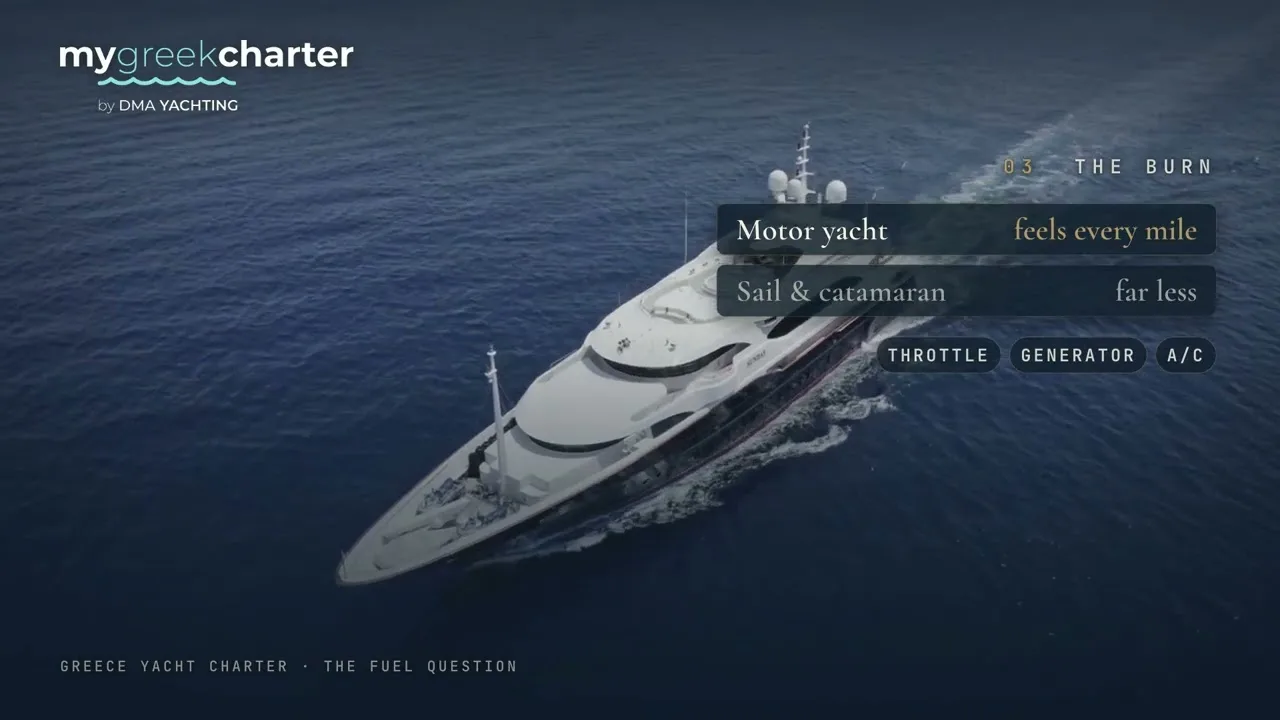
Watch: our fuel explainer shows why yacht type, route, speed, and APA matter more than a single headline charter price.
Fuel Matters Most on Motor Yachts
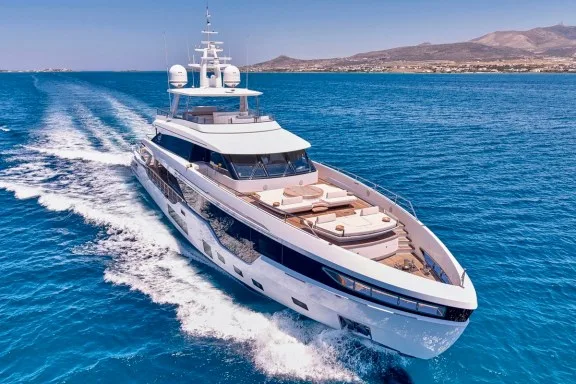
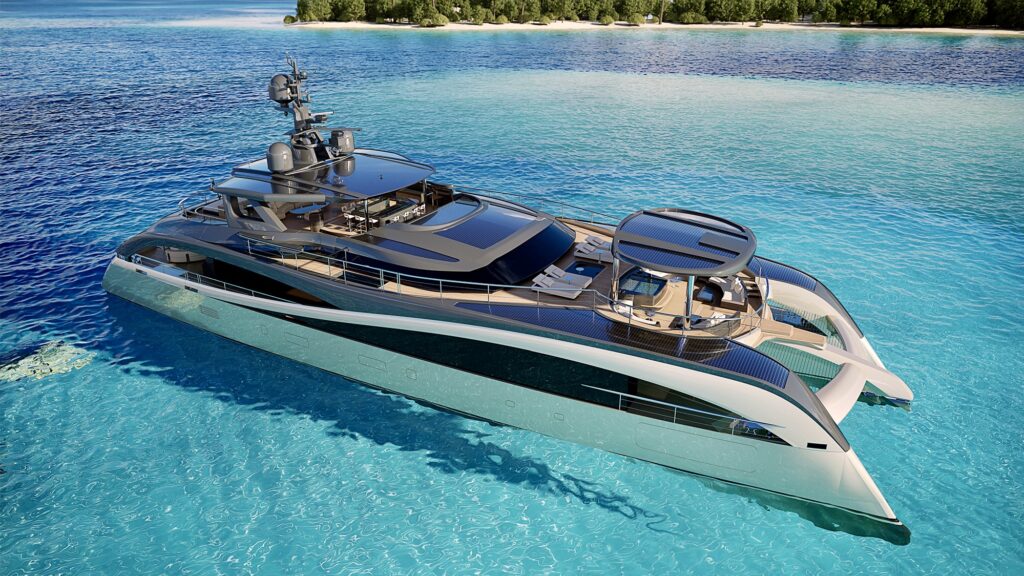
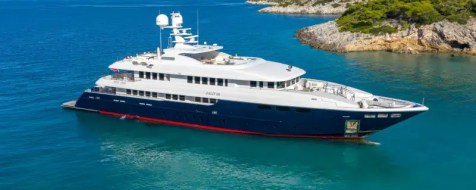
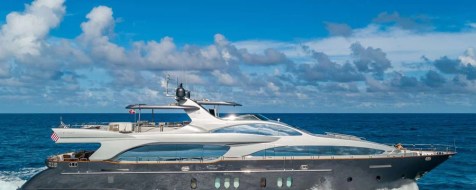
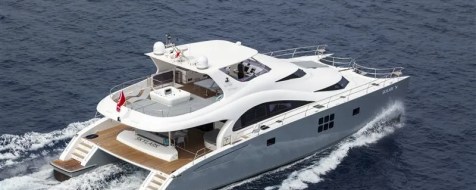
This is the first place we look when clients ask whether fuel should worry them. Fuel matters much more on motor yachts than on catamarans or sailing yachts because speed, engine load, hull type, and cruising profile change the burn rate quickly.
That does not mean motor yachts are a bad choice. Often they are exactly the right choice, especially for tighter Cyclades weeks or faster point-to-point concepts. It just means fuel is a more important planning variable in that part of the market. If you want the full yacht-type comparison, our guide to motor yacht vs catamaran in Greece connects directly to this fuel question.
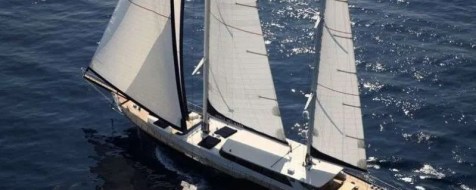
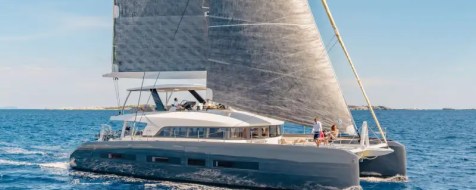
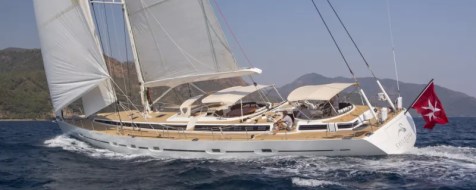
Catamarans and sailing yachts still use fuel. They may motor in light wind, run generators, use air conditioning, operate the tender, and adjust for weather. Power catamarans also need their own fuel check. The difference is that on many normal Greece routes, fuel is less likely to become the deciding budget factor unless the route is unusually ambitious.
The Route Changes Everything
A relaxed week close to Athens is a very different fuel story from an aggressive island-hopping plan in the Cyclades. This is where clients often underestimate the difference. The route looks easy on the map, but in practice the fuel outcome changes sharply once the distance, pace, and required cruising hours rise.
In Greece, the biggest route split is often between the Cyclades, Ionian, and Saronic. The Saronic is usually the easiest fuel environment because a week can stay compact around places like Aegina, Poros, Hydra, and Spetses. The Ionian is often manageable on a sensible loop around Corfu, Paxos, Lefkas, Meganisi, or nearby islands. The Cyclades are where fuel becomes much more important because the distances are longer and the itinerary pressure is usually higher.
If a client asks us whether fuel should be a major concern, the first thing we ask is not only the yacht name. It is the route. That tells us much more, much faster, about whether fuel is likely to stay modest or become a serious discussion point.
Why the Cyclades Push Fuel Up Faster
The Cyclades are where we see fuel matter most often, especially on motor yachts. The reason is not just the destination itself. The real issue is that clients usually want a more ambitious week there. Mykonos, Paros, Ios, Milos, and Santorini are not all sitting close together in a way that makes fuel irrelevant.
As a rough planning reference, Athens to Mykonos is often around 85-90 nautical miles, and Athens to Santorini is often around 130-140 nautical miles, depending on the exact start, end, and routing. Once a 7-day charter tries to connect several headline islands, the yacht has to work harder, especially if the weather does not cooperate.
A real type of situation we see: a 75ft motor yacht doing a Santorini-inclusive Cyclades plan can quickly become a 300+ nautical mile and roughly 15-hour fuel conversation before generator use, tender use, and weather adjustments are even finalized. That does not mean the route is impossible. It means it needs to be costed like a real route, not treated like a pretty line on a map.
This gets even more pronounced when clients start in Athens and want the outer islands quickly. Our articles on whether to start in Athens or in the islands, round trip vs one-way in Greece, and how far you can really go in 1 week in the Cyclades all connect back to the same fuel reality.
Speed Changes the Number Fast
Fuel is not only about distance. Speed matters too. Faster cruising can move the fuel number much more than clients expect, especially on motor yachts. Two charters that look similar on paper can land in very different places once the actual running profile is factored in.
This is why we ask about realistic cruising speed, not just the yacht’s top speed. A captain may be able to run faster, but the economical speed is often a very different conversation. We also look at whether the route is forcing the yacht to run hard day after day, because that is where a lower weekly rate can become less attractive once APA is considered.
One-Way Charters and Delivery Legs Can Raise Fuel Further
One-way charters can be excellent, but they can also raise fuel-related costs. Sometimes they are worth it because the guest route becomes much better. Sometimes they are not. The important part is knowing whether the one-way structure removes enough wasted movement during the week to justify the delivery or repositioning logic around the yacht.
We recommend one-way when it solves a genuine route problem. We do not recommend it just because it sounds more glamorous. For example, a Santorini finish may look attractive on paper, but it can add port logistics, delivery planning, extra time, or dinghy transfer complications. In some cases, ending in Paros or Mykonos and flying or ferrying onward is cleaner than forcing the yacht into a less efficient finish.
For one-way charters, we always check whether delivery fuel, repositioning time, marina fees, crew logistics, and any applicable taxes are included in the offer or charged separately. This is not a detail to leave until the contract stage.
How Fuel Is Estimated and Paid
On most crewed Greece yacht charters, fuel is not included in the base charter rate. It usually sits inside APA or trip extras, which is why clients can be confused if they compare yacht rates without understanding what still has to be funded on top.
The practical version is simple: we estimate fuel after we know the yacht, route, start and end points, target cruising speed, and whether delivery legs apply. The captain and yacht manager can then help estimate expected running hours and fuel consumption. After the charter, expenses are reconciled against actual use. If APA is unused, it is normally returned. If the charter spends more than expected, the client may need to top up or settle the balance.
Fuel prices also change, so we do not like building advice around a single outdated per-liter number. We prefer to check current pricing and the yacht’s actual consumption profile when the itinerary is being planned. If you want the operational version of APA, our guides to all-inclusive vs APA in Greece and how APA works are the right follow-up reads.
Broker insight
Fuel is almost always paid from the APA, so it is a real cost rather than a fixed line on the invoice. On a fast motor yacht crossing the Cyclades every day it can run into the thousands, but slow that same boat down or keep it closer to Athens and the number drops fast. We estimate it against the real route, never as a random figure.
 Martina Asmus
Owner, Charter Broker, Active CYBA Member, IYBA, ECPY
Martina Asmus
Owner, Charter Broker, Active CYBA Member, IYBA, ECPY
Questions We Ask Before Estimating Fuel
This is where route planning matters more than fear. We do not try to scare clients away from motor yachts or from the Cyclades. We help them understand which choices drive fuel up and which changes can keep the trip more balanced.
Before we treat any fuel estimate as useful, we want answers to these questions:
- What yacht are we estimating for, and what is her consumption at the planned cruising speed?
- What is the proposed start point, end point, and route?
- How many cruising hours are expected?
- Does the itinerary include delivery or repositioning legs?
- Does the estimate include generator use, air conditioning, tender use, and water-toy use?
- What happens if weather forces a route change?
- How often will the captain or manager update the APA balance?
- When and how is unused APA returned?
Sometimes the answer is to tighten the route. Sometimes it is to change the start point, choose a more efficient yacht, reduce the island count, cruise slower, or accept that a bigger or faster yacht is the better fit. Smarter planning does not always make the total charter cheaper, but it helps avoid choosing a lower weekly rate and then forcing that yacht into an expensive route.
If clients want the bigger cost picture beyond fuel, our Greece yacht charter cost guide, fuel-efficient yacht shortlist, and step-by-step booking guide help tie the whole budget together.
Our Recommendation
Fuel cost only becomes useful when it is tied to the actual trip. That is why we do not treat it as a stand-alone number. We treat it as the outcome of the yacht, route, speed, weather, delivery logistics, and style of week the client is trying to have.
For most easier Greece charters, fuel does not need to become a source of anxiety. For motor-yacht charters, longer Cyclades routes, one-way concepts, and high-ambition island lists, it needs to be part of the planning conversation early. That is where we help most: turning fuel from a vague worry into a manageable decision factor.
People also ask
Does fuel cost a lot on a Greece yacht charter?
Sometimes. Fuel can be minor on a relaxed catamaran or sailing-yacht week, but it can become a major budget factor on a fast motor-yacht charter with longer or more ambitious routes.
Is fuel included in the charter fee?
Usually not. On most crewed Greece charters, fuel sits inside APA or trip extras rather than the base charter fee.
Will unused APA be returned after the charter?
Normally, yes. APA is a working account for charter expenses. After the charter, the yacht reconciles actual expenses and unused APA is normally returned, while overspend may need to be settled.
Can the captain estimate fuel before we sign?
Usually, yes, once the yacht, route, start and end points, and approximate cruising pace are clear. We recommend asking for an itinerary-based estimate instead of relying on a generic fuel number.
Which yacht type is most fuel-sensitive?
Motor yachts are the most fuel-sensitive. Catamarans and sailing yachts are usually much less affected on normal Greece routes, although they still use fuel for motoring, generators, air conditioning, tender use, and route adjustments.
Do the Cyclades cost more in fuel than the Saronic?
Often, yes. The Cyclades tend to involve longer distances, more exposed crossings, and more ambitious routing, which is why fuel usually matters more there than on a compact Saronic week.
Can a one-way charter increase fuel costs?
Yes. One-way charters can improve the guest route, but they can also raise fuel, delivery, repositioning, marina, and crew-logistics costs. The important question is whether the route benefit justifies that extra spend.
Will a smaller group spend less APA?
Sometimes, but guest count is only one part of APA. A smaller group may spend less on food and drinks, but fuel depends more on the yacht, route, speed, generator use, tender use, and weather.







 iMessage
 WhatsApp