You have had the brilliant idea of chartering a yacht in Greece for your next holiday with your family or friends, but you have never done it before and you’re not sure whether a motor yacht or a catamaran is the better choice.
You are not alone. This scenario fits 50% of our clients when they first inquire, and we solve it every time.
| Catamaran | Motor yacht | |
|---|---|---|
| Under €60k a week | More space per euro, newer luxury models | Usually older, with less space |
| €60k to €100k | Great value, but you cover less ground | Range, and you keep your schedule |
| Above €100k | Fleet thins out | Where most Greek charters land |
| Itinerary style | Relaxed, short island hops | Freedom to move, ambitious routes |
| Athens to Santorini | Unrealistic in a week | Much more doable |
| Fuel and APA | Low burn, APA 20-25% | Higher burn, APA 30-40% |
Broker insight
Under €60,000 a week the catamaran wins almost every time. That budget buys a brand new cat with proper space and good toys. The motor yachts in that bracket are older or smaller, and they burn a lot more fuel, so the real weekly cost is higher than the rate suggests. It is the one bracket where I do not think it is a close call.
 Daniel Asmus
Owner, Charter Broker, Active CYBA Member, IYBA, ECPY
Daniel Asmus
Owner, Charter Broker, Active CYBA Member, IYBA, ECPY
It isn’t entirely black and white. Your best match also depends on
your budget for the week, the needs of your group, and your ambitions for your itinerary.
Hear it from our brokers
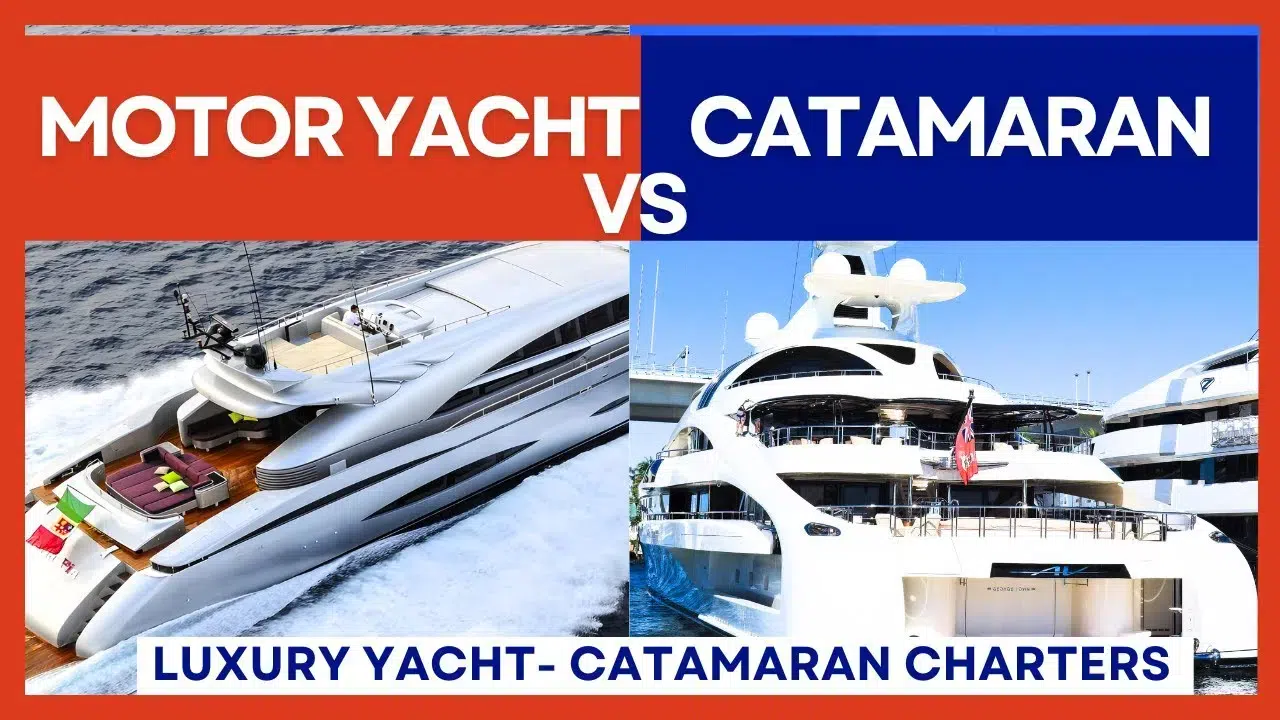
In the video below, our brokers break down how the two types compare in plain terms. There is also a third option that sits between them: the power catamaran, which pairs catamaran living space with engines instead of sails, and burns less fuel than a motor yacht of similar size.

Step 1: What is your budget?
Budget narrows the field fastest, because the same money buys a very different boat depending on which type you choose.
If you are looking for a yacht under €60,000 a week, we almost always recommend a catamaran. Motor yachts in that bracket tend to be older, while the same budget puts you on a recent catamaran with current toys and a crew of three or four.
Between €60,000 and €100,000 you can choose. A catamaran at this level is a floating villa with enormous deck space and the best value per euro you will find. A motor yacht gives you range, and covers in an afternoon what a catamaran would spend a full day on.
From €100,000 you have moved into motor yacht territory. This is where most of our Greek charters land, and where the question stops being about type. You are looking at motor yachts with the crew, range and amenities of a small resort.
Step 2: How far do you want to go?
If you’re set on Athens → Mykonos + Santorini → back, there’s usually no point considering a sailing catamaran. Why? That routing involves open sea in the windiest part of Greece, and it’s a lot of mileage (more than 300 nautical miles)-especially in high season when the Meltemi can blow hard. Trying to force a big-distance Cyclades week on a catamaran is one of the fastest ways to create an uncomfortable trip.
This is the best way to look at it:
Catamarans are best for short, relaxed island-hopping, where the focus is spending time at anchor, swimming, and exploring ashore. It makes a perfect beachfront base – its shallow draft means you can get real close to shore.
The best places to go on a catamaran in Greece are the Saronic Islands, which are located just south of Athens in the Saronic Gulf, which is more protected from the Meltemi than the Cyclades. And the Ionian Islands, on the other side of the peninsula, which are much calmer in general and have tons of beautiful islands in protected water – ideal to explore with a catamaran.
Motor yachts basically give you access to all of Greece. It is the best choice for Athens to Cyclades yacht charters, full Ionian loops from Corfu to Zakynthos and back, and more remote itineraries to the stunning Dodecanese Islands closer to Turkey.
This doesn’t mean a motor yacht makes weather irrelevant. We’re always transparent about Greece’s realities-especially in the Cyclades. The difference is that a motor yacht gives you the best chance of keeping the week comfortable and still seeing what you came for.
Step 3: What does your group actually need onboard?
This is the part most first-time clients don’t think about-and it matters as much as distance. If you’re a mixed group with kids or anyone prone to seasickness, we often lean toward a catamaran for the stability, space, and easy “beach-house” living at anchor. Or a motor yacht with efficient stabilizers.
If you’re a group that values privacy (couples, executives, or anyone who wants more separation), a motor yacht often wins on cabin privacy, service level, and onboard flow. And if your group is large, layout becomes everything: number of equally sized cabins, bed configuration (twins vs doubles), and how the yacht handles everyone dining and relaxing together. Tell us your group setup-and we’ll recommend the yacht type that fits how you’ll actually use the boat.
Broker insight
Catamarans give you space and shallow anchorages for the money, motor yachts give you speed and range. In the open Cyclades that speed buys comfort, in the Ionian the catamaran often wins.
 Louis Lamprell
Charter Broker, Active CYBA Member
Louis Lamprell
Charter Broker, Active CYBA Member
Does fuel change the real cost of your charter?
Fuel is the part many charter sites don’t explain well, but it matters-because it can change the final cost by thousands over a week.
Even two motor yachts of similar size can have very different fuel burn – the difference can be 300 liters vs 700 liters per hour. Multiply that by 2–4 cruising hours per day, and the numbers add up fast. That’s why we include fuel consumption wherever possible and talk clients through what it means for their route and cruising style.
If you charter a catamaran, this will hardly be a concern. The fuel consumption of catamarans is very low compared to motor yachts, which is also why the APA is set lower to begin with.
People also ask
Are power catamarans good in rough water?
For the conditions you meet on a charter week, yes. A power catamaran sits level at anchor and does not heel under way, so life on board stays steady and nothing slides off the table. It is not a heavy-weather boat though, and a strong Meltemi still makes for a bumpy crossing. If your route is built on long Cyclades legs in July or August, a motor yacht with working stabilizers will be more comfortable. Browse our power catamarans in Greece.
Do you actually sail in Greece, or motor most of the week?
It depends where you go. In the Cyclades in high season the Meltemi delivers real wind, and a sailing catamaran will sail a good part of the week. In the Saronic and the Ionian the wind is lighter and more of the week is under engine. Crews sail when the route and the wind line up, and motor when they do not, so if the sailing itself matters to you, say so when you book. More on the Meltemi wind.
Which type is better if someone gets seasick?
Neither is a cure, and the route matters more than the hull. A catamaran is the steadier platform at anchor, where you spend most of your time. A motor yacht with working stabilizers is steadier underway. Shorter hops in protected water do more for seasickness than either choice, which is why we often move a nervous group to the Saronic or the Ionian. More on seasickness on a Greek charter.
What are the disadvantages of a power catamaran?
Availability, mostly. The Greek fleet is small, so the good ones go early for July and August. They are also slower than a planing motor yacht, so a long Cyclades leg takes longer. And they cost more than a sailing catamaran of similar size, because you are paying for the engines and usually a newer boat.